
Research
Science: Peking University team cools atoms below 10 picokelvin aboard China's space station
Peking University said on November 6 that its team and the Shanghai Institute of Optics and Fine Mechanics produced an ultracold atomic gas below 10 picokelvin with an expansion lifetime of more than 7 seconds on China's space station, in a paper published in Science on November 5.
- Who
- Peking University; Shanghai Institute of Optics and Fine Mechanics, CAS
- What
- Produced an atomic gas below 10 picokelvin on China's space station
- When
- Paper published in Science 2026-11-05; university release 2026-11-06
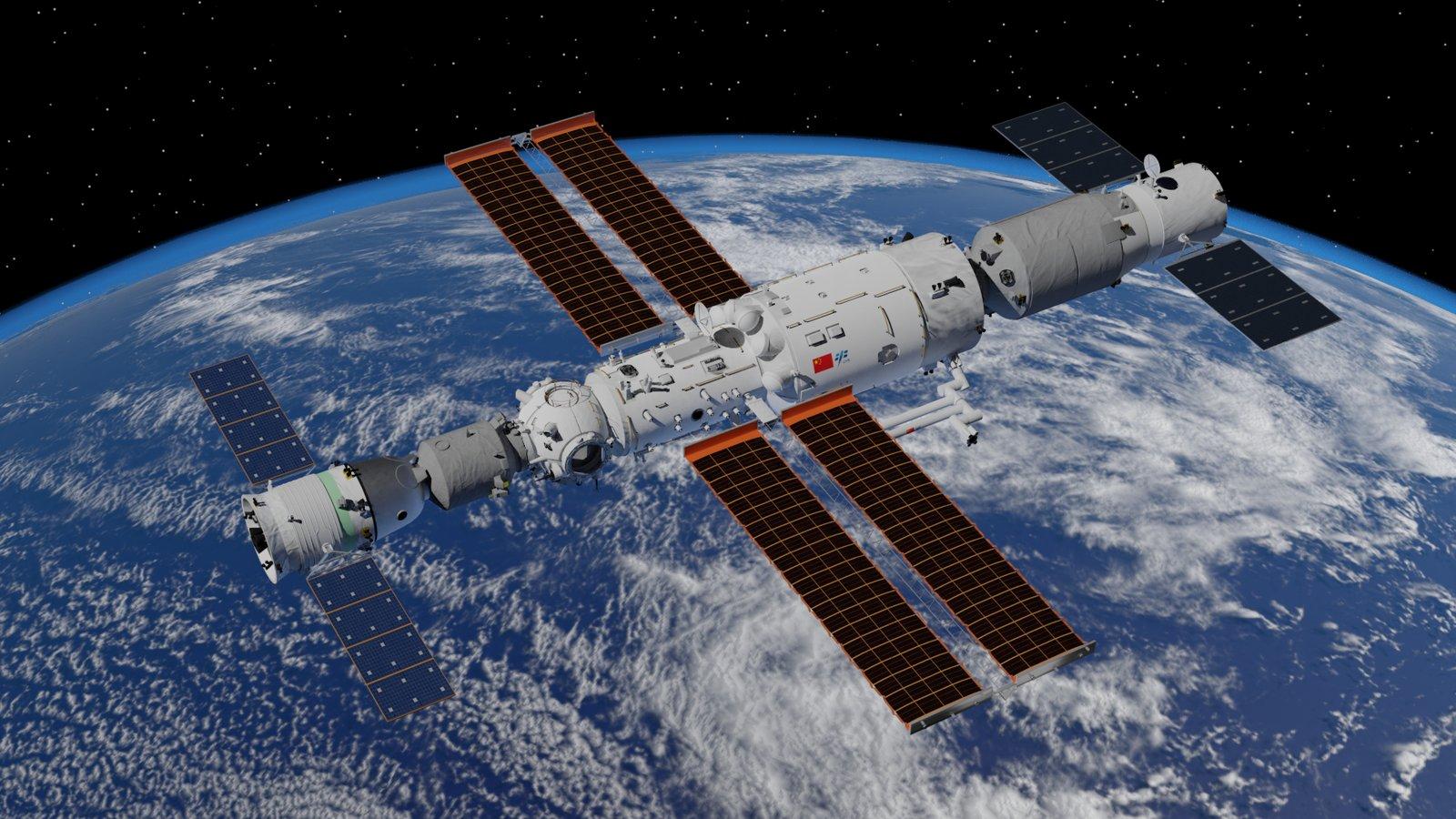
Image: Shujianyang / Wikimedia Commons / CC BY-SA 4.0
Editor:管理员|Signed:2026-11-24 08:52
A team led by Chen Xuzong and Zhou Xiaoji of Peking University's School of Electronics, working with engineers from the Chinese Academy of Sciences' Shanghai Institute of Optics and Fine Mechanics, produced an ultracold atomic gas below 10 picokelvin on the space station's ultracold atom physics rack, Peking University said on November 6, 2026. The gas had an expansion lifetime of more than 7 seconds and a calibrated temperature of 9.7 picokelvin. The paper, "Quantum Gases Below 10 Picokelvin in Space", was published in Science on November 5. The university said the previous known record in space was 38 picokelvin with a two-second lifetime, set with a space atom chip.
The rack was developed by the Shanghai institute and Peking University from 2015 and reached the station in October 2022 aboard the Mengtian module. The team used a two-stage crossed-beam cooling scheme with laser beams of different waist sizes and trap depths. On the ground, gravity limits such cooling to the nanokelvin range. The university said the platform could support research in quantum many-body physics and precision measurement in space.
Corrections
If a fact is wrong, the correction and date go at the top. Principles
 Tsinghua team uses LLMs and diffusion models to screen nearly 70,000 structures for low-lithium solid electrolytes
 Science: Zhejiang University team braces perovskite grain boundaries with nanodiamonds, reaching 27.04% certified efficiency
 Chinese Academy of Sciences team turns magnetic tunnel junction noise into calibration-free power-law computing for edge AI
