
Research
Science: Zhejiang University team braces perovskite grain boundaries with nanodiamonds, reaching 27.04% certified efficiency
China News Service reported on November 20 that a Zhejiang University team published work in Science tracing perovskite instability to mechanical differences inside the film, and stiffening grain boundaries with diamond particles about 10 nanometers across.
- Who
- Zhejiang University State Key Laboratory of Silicon and Advanced Semiconductor Materials
- What
- Stabilized perovskite solar cells with nanodiamonds at grain boundaries
- When
- Published in Science 2026-11-20
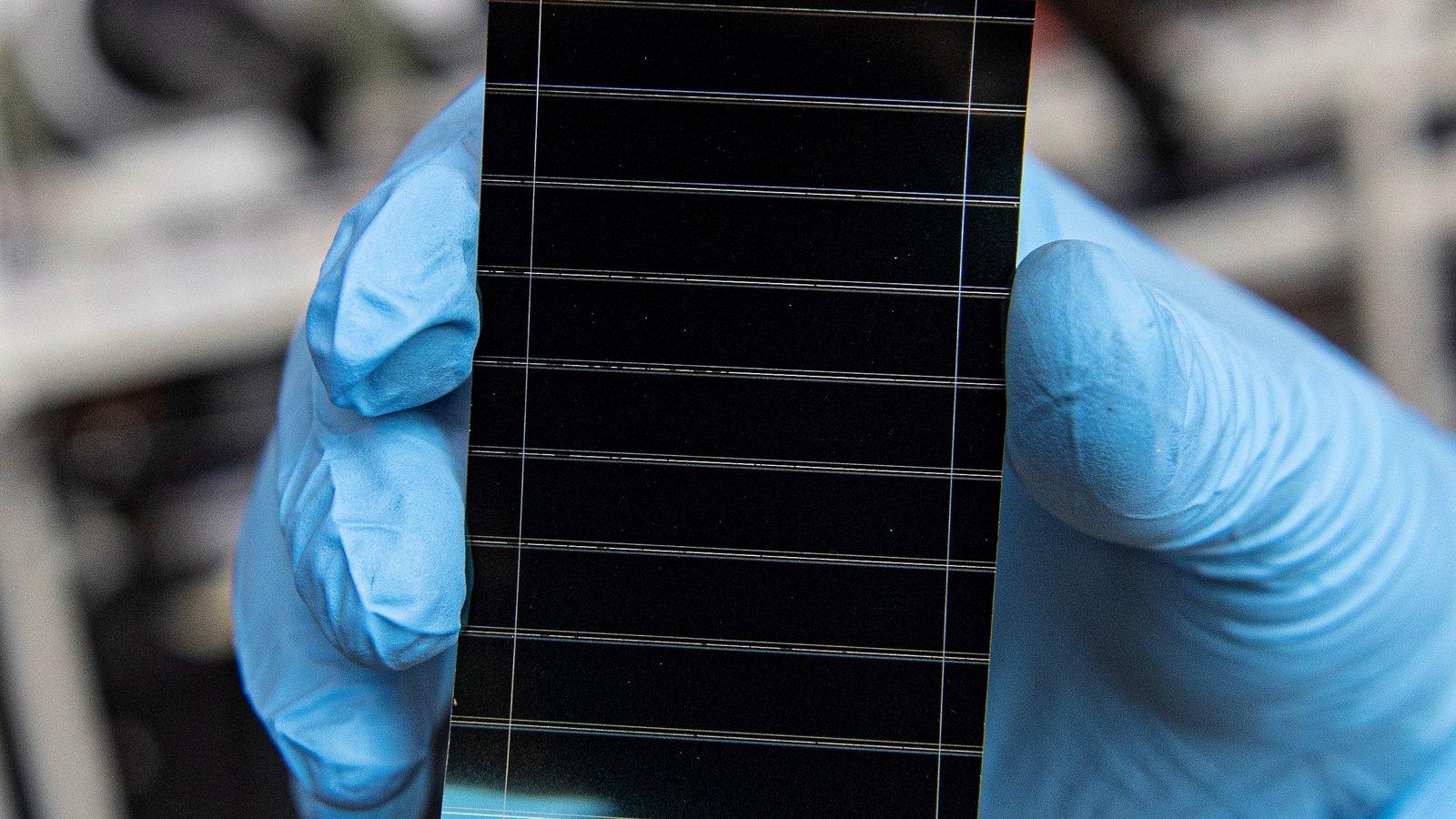
Image: Dennis Schroeder / NREL / Wikimedia Commons / Public domain
Editor:管理员|Signed:2026-11-24 08:52
A team at Zhejiang University's State Key Laboratory of Silicon and Advanced Semiconductor Materials published "Elastic-field reorganization stabilizes soft-lattice perovskites for durable solar cells" in Science on November 20, 2026, China News Service reported. Using an in-situ nanoindentation platform, the researchers found that under the same load, grain boundaries in perovskite films creep far more than grain interiors, a mechanical mismatch that wears the film down through daily heating and cooling.
Adding diamond particles with an average diameter of about 10 nanometers reorganized the film's elastic field so stress no longer concentrated at the boundaries. The report said the cells reached a certified steady-state efficiency of 27.04%, and after 5,000 hours of simulated day-night light cycling kept more than 90% of their initial efficiency, against about 50% for control cells. Stability has long been the main barrier to commercial perovskite cells; this is a materials-level approach, and manufacturing and cost questions for full modules remain open.
Corrections
If a fact is wrong, the correction and date go at the top. Principles
 Science: Peking University team cools atoms below 10 picokelvin aboard China's space station
 Tsinghua team uses LLMs and diffusion models to screen nearly 70,000 structures for low-lithium solid electrolytes
 Chinese Academy of Sciences team turns magnetic tunnel junction noise into calibration-free power-law computing for edge AI
